An independent studio
3rd From The Sun
A small studio building artificial-intelligence software, shown with its limits attached. Twenty-one products, and nine of them run in this browser — pick one and use it, with no install and no account.
- Applied AI
- Agent tooling
- Privacy-first engineering
- Data and measurement
Nothing on this page is tracked: no analytics, no hosted fonts, no third-party request. It renders the same with the network switched off.
This is what it does
Nine builds you can use right now
Not videos of software. One product at a time, in the frame below — each is the product’s own client-side build, and where a product needs a backend its own mock runs in the page instead, so nothing you type leaves the tab.
Runs in your browser — nothing to install
- Nine builds, one at a time. Each product page states the exact scope of its own demo, including what it cannot do yet.
- Three more products run outside the browser — GhostScrape, GhostWriter and PhishGuard — and each of their pages opens on what you can use there.
- Frontier Terminal runs live as a hosted service, with its own database and a 30-minute schedule. Open the hosted beta.
Products
Software from the studio
Each product lives on its own page, with its measured state on its own card — a directory under this domain, or, for tallow, its own deployment. The label on each card is the state today, not a forecast.
Twenty-one products, grouped by the kind of thing they are.
Concord
One control library for NIS2, DORA and GDPR: assess once, see which controls satisfy all three regimes, and get a sequenced roadmap with an evidence register. The demo runs the product’s real Rust engine in the browser — no account, no server, nothing leaves the page.
Ink Stamp
Press and hold, and a specimen hatches under your finger — a little specimen with one part that never belongs; the second touch copies it as plain text fitted to Messenger, Gmail or Discord. No image, no account, nothing leaves the page.
Eject Doctor
Names the exact program that is stopping an external drive from ejecting, by reading Windows’ own refusal record rather than guessing — then closes the blocker politely and retries. A free Windows download: no install, no account, no admin rights.
GhostWriter
Cold email rewritten to sound like the person you are writing to, with a Brand Voice Lock for teams. You pay per send rather than per seat.
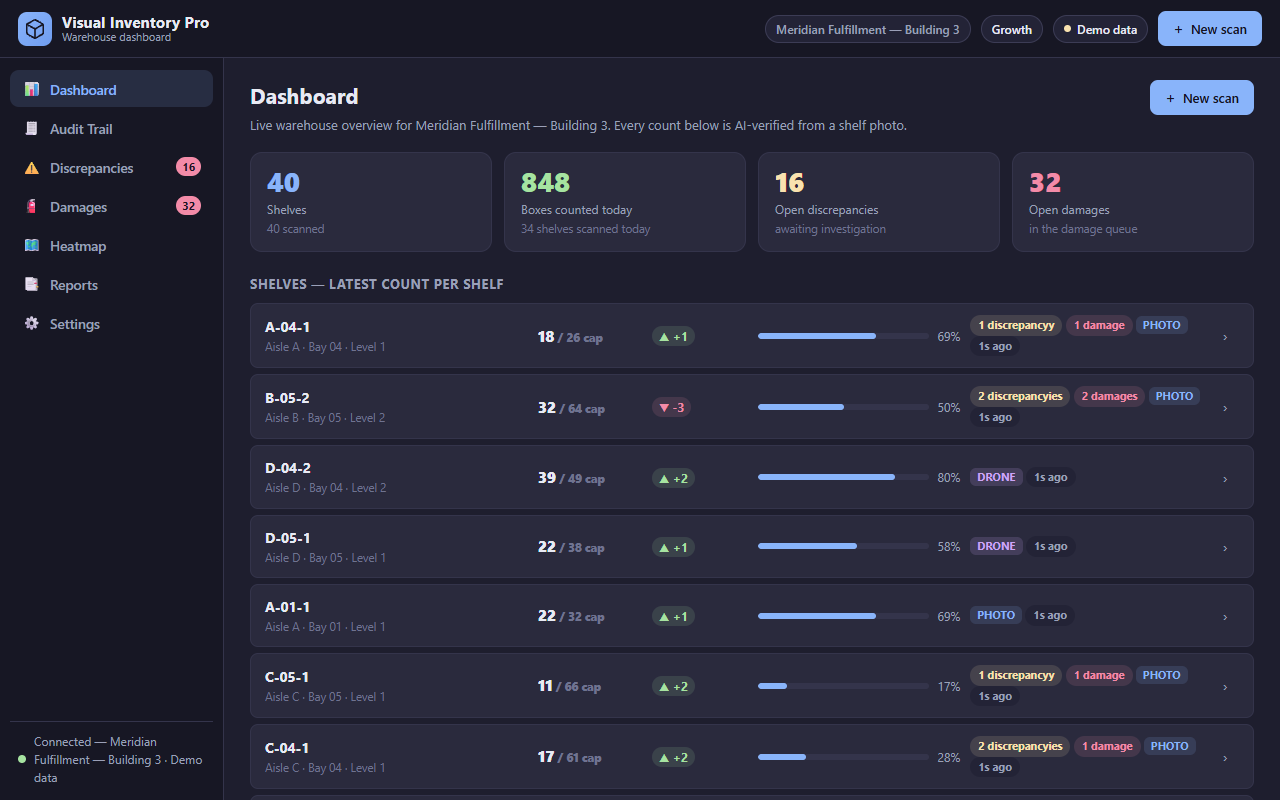
Visual Inventory Pro
Shelf photographs turned into box counts, damage flags and an audit a warehouse can argue with. Sold per site, not per seat.
Pawsight
A short video of a pet, read for movement, posture and breathing, and answered with a triage verdict. An aid to a decision, never the diagnosis.
PhishGuard
Single-use, short-lived verification links that replace texted one-time codes for teams that would rather not send them.
ShiftSwapper Pro
Shift swapping and earnings for hourly teams, with the manager approving the change. Priced per location rather than per employee.
LegacyVault
A zero-trust legacy vault: your secrets split three ways with Shamir, released to the people you named only after an inactivity dead-man’s switch fires.
Frontier Terminal
SEC filings, insider Form 4s, tick data and news sentiment scored into one cross-source signal — with the confidence attached, not hidden.
PreLawyer
Anonymous legal matching: a case becomes a strength estimate and a deadline warning before a lawyer ever learns your name — and you choose when they do.
Privacy Butler
Rejects consent banners by default, names the dark patterns, blocks the tracking, and drafts the data-access requests you are legally owed.
Orbit Plugin Kit
Schema, packer and test harness for building plugins a marketplace can actually sell — with a refusal built in for anything that looks like a private key.
GhostScrape
Scraping that heals itself: selectors repair when a site changes, and every credential lives in an AES-256 vault that re-locks on restart.
pst-tool
Outlook .pst extraction done the way forensic and migration work actually needs it: every folder, every body, every attachment, with provenance.
WordPress Hardening
One drop-in file that closes WordPress user enumeration at the API layer — verified deployed and server-linted.
Screenshot Assistant
Capture anything on screen and get it explained — OCR plus a model, as a single Windows tool instead of five tabs.
InfluencerBooster
Reads a video’s retention curve and points at the exact second viewers leave — with every figure traceable back to the creator’s own words.
RetroSkin
A Tron-aesthetic skinning suite — neon live wallpapers with racing light cycles, battery-aware and smooth at a locked frame rate.
The Anti-App
Offline daily quests proved by camera. No feed, no streak guilt, no engagement loop — the whole point is that you put it down.
tallow
A novel you have to repair. You are handed a dead man’s repository with a program that will not start; the comments are the confession and the commit history is the evidence. It ends with you writing one line into the drive.
Beta programme
Eleven packages you can test today
The studio’s most complete work, open to test right now: a hosted service, four builds you can open in this browser, two browser tools that work on a file or a manifest you choose, one download that runs on your own machine, one installable app, and two packages waiting on a carrier registration rather than on code.
- 1 hosted service
- 6 in-browser
- 1 download
- 1 installable app
- 2 by invitation
Using any of them means accepting the beta terms — short, and they state what a beta is, how each product is scoped, and that nothing in the programme is sold.
The studio
One studio, no layers, no outside funding
The studio builds artificial-intelligence software and tools. It is not an agency and not a platform company: it works on its own problems, at its own pace, and answers for the result.
It has taken no outside funding, so every decision stays reversible by the people who made it and there is nobody to keep happy but the work.
Being small is the method, not the mood. A studio with no layers finds out that something is wrong earlier, because the person who built it is also the person who has to say so.
Method
How the work actually goes
The method is not clever. It is mostly a refusal to skip the boring part of the job.
Write the problem down first
Every build starts as a short written brief: what the problem is, what a good outcome looks like, what would count as failure, and what is out of scope. Prose is far cheaper to fix than code.
Build the smallest real thing
The first version is narrow on purpose and meets real inputs early. Real inputs are where a build proves itself — the sooner it meets them, the sooner a wrong assumption is cheap to find and cheap to fix.
Choose the measurement first
How the result will be judged is decided before the build, not after it. A measurement chosen afterwards is a justification, not evidence.
State the limits in the same breath
Anything written about a system carries what that system cannot do, in the same document and the same voice as what it can.
Make failures loud
A fault that is quietly absorbed is the most expensive kind, because nobody learns from it. Systems are built to say what went wrong and where, rather than to keep going and hope.
Keep the surface small
Every feature is something that must later be explained, tested and maintained. Scope is cut before it is built, not after a deadline has already been missed.
Principles
What we will not do
A principle is only worth writing down if keeping it costs something. These cost flexibility, and they are kept anyway.
- We will not call something finished because it runs. It is finished when it has been tested against the case it is for, rather than the case that flatters it.
- We will not publish a number we cannot reproduce. If nobody else can measure it again, it is an anecdote.
- We will not treat a limit as an afterthought. Whatever is said about a system carries what it cannot do, in the same place and at the same volume.
- We will not collect data a feature does not need. Where a design can keep someone’s information on their own machine, that is where it belongs.
- We will not sell, rent or trade personal data — and we will not build something whose business only works if we do.
- We will not announce a date we cannot hold, or describe something as ready while it is still in pieces.
Capabilities
The kinds of work this studio is built for
Each of these is a discipline the studio works in — the equipment behind the products above rather than a sales list.
Applied AI
Making a model do one specific thing well, then making it dependable: evaluation, failure handling, latency, cost, and knowing where the model should not be trusted at all.
Agent tooling
The unglamorous half of software that takes actions on its own: tool interfaces, permissions, review points, logging, and what happens when a step fails halfway through.
Data and measurement
Deciding what is worth measuring before anything is built, then building the instrumentation first, so the answer exists by the time someone asks the question.
Privacy-first engineering
Designing so the safest handling of someone’s data is also the default one: local where local is possible, encrypted where it travels, collected only where a feature genuinely needs it.
Product design
Interfaces that explain themselves, and decisions that can be defended in a single sentence. A feature that needs a paragraph of apology is the wrong feature.
Developer tools
Command-line and local-first tooling that starts quickly, works without a network, and sends data nowhere it does not have to go.
Also: evaluation, and local-first software.
Working together
How an engagement runs
Short, written and unceremonious. The shape is the same whether the job is three weeks or three months.
A written brief
We start with a page, not a call: the problem, who it is for, what success looks like, and what is explicitly out of scope. If that page is unconvincing, nothing gets built — which is the cheapest possible place to fail.
A small, real build
The narrow version goes up early and meets real inputs, while it is still cheap to discover that the approach was wrong.
Measurements, then judgement
The agreed measurement is run and reported as it comes out, including when it comes out badly. A number that only ever appears when it is flattering is marketing.
A plain handover
The work arrives with its notes: what was built, how it is measured, what it depends on, and where it is weak. Nothing that requires tracking down a former contractor to understand.
How it is published
Every product page speaks for itself
The studio puts each product on its own page and lets that page carry the detail, so nothing here has to be taken on trust.
- Each product has its own directory under this domain, and each one states its own state, its own scope and its own measured numbers on the page it belongs to.
- Work is shown when it is finished rather than trailed in advance: no dates, no queue, and no placeholder that has to be walked back later.
- No third-party requests. This page loads no analytics, no hosted fonts and no external images, so it renders identically with the network switched off.
Write to the studio
The feedback form is the whole front door. If you have a problem worth a written brief — or you want to know how the studio would approach one — write it there.
One person reads it, and the reply will be an actual answer rather than a form letter.